A Map of Immunological Theories
Synopsis of the Immunological Theories
Though differing in degree of generality, all theories of immunological recognition, tolerance, memory, and self-regulation focus on distinct aspects of the immune system. Most of them have at times been defended as overarching immunological theories, but they are all ultimately explanations of key immunological phenomena. Only when combined do they begin to build the puzzle of the immune system.
Here is a term map, grouped by theory and centrality, based on Martins, et al. (2024)1.
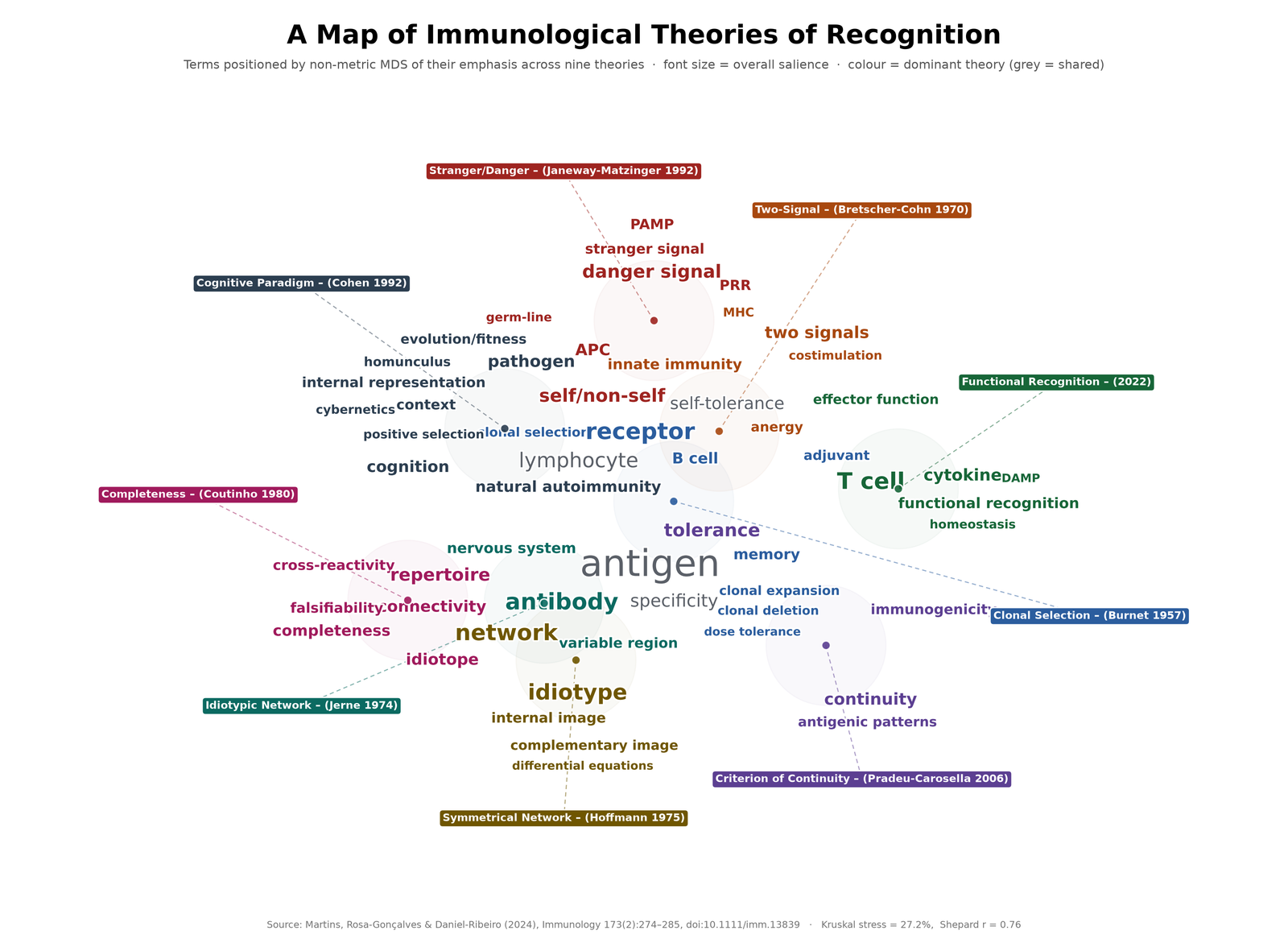
In the figure above, the positions of the concepts and the centers for each theory reflect their centrality relative to overall term usage. Accordingly, the most central concepts come from the fundamental Clonal Selection Theory. The more peripheral concepts appear in only a few theories. The font size is proportional to the number of times a concept is used, and the color of the nodes indicates the theory to which they typically belong.
What Each Theory Explains — and Fails to Explain
The table below summarizes, for each theory, the phenomena it accounts for, the phenomena it cannot accommodate, and the specific tenets that have been most decisively contradicted by experiment. It is based on Martins et al. (2024)1 and on the broader critical literature on each theory. “Refuted concepts” is used in the strong sense — claims that were falsified by direct evidence — and is distinguished from mere explanatory gaps in the “Does not explain” column.
| Theory | Explains | Does not explain | Refuted concepts |
|---|---|---|---|
| Clonal Selection Theory (Burnet, 1957)2 | Antigen-specific immunity and tolerance; clonal expansion and memory from a single-specificity precursor; somatic generation of the repertoire; central deletion of self-reactive clones | Positive selection; the requirement for adjuvants and “context”; natural autoantibodies and physiological autoimmunity; low- and high-zone tolerance; T–B cooperation; idiotypic connectivity | “One cell, one receptor”: dual-TCR (and dual-BCR) cells with two functional specificities occur normally, so allelic exclusion is not absolute3. Antigen alone is sufficient to activate lymphocytes (the “immunologist’s dirty little secret” — adjuvant is required)1 |
| Two-Signal Theory — T help (Bretscher & Cohn, 1970)4 | Why anergy exists and is needed; the hapten–carrier effect; self-tolerance of newly arising clones via signal-1-only inactivation | How the helper itself avoids the self-tolerance regress; antigen-independent T-cell development; naive T cells transferred to MHC-deficient hosts | The idea that self/non-self discrimination is decided purely at the level of two antigen-specific lymphocytes; costimulation was shown to originate from non-antigen-specific APCs, not a second specific cell5 |
| Two-Signal Theory — APC (Lafferty & Cunningham, 1975)6 | Alloreactivity; the role of the APC-derived second signal (costimulation) in licensing responses | Why costimulation itself is switched on or off; how the APC “knows” when to deliver signal 2 | Costimulation as an antigen-specific, constitutive property — it is instead induced by innate recognition, requiring the later PRR/danger refinements1 |
| Functional Recognition Theory (2022)7 | Type-2 immunity to helminths, allergens and toxins that share no structural motif and are not sensed by PRRs; recognition by functional activity (proteases, DAMP release, neuron activation) | How adjuvant-free Th2 immunogens elicit adaptive memory; how type-1 vs type-2 innate/adaptive arms are differentially triggered; barrier tissue-resident memory | Still provisional and largely untested; no tenet is “refuted” so much as unvalidated — it inherits the danger theory’s difficulty of defining the triggering property non-circularly1 |
| Stranger / PRR Theory (Janeway, 1989/1992)8,9 | Why adjuvants work; innate control of adaptive activation; germline-encoded PRR recognition of PAMPs; discrimination of “infectious non-self” | Sterile inflammation; transplant rejection; anti-viral and anti-tumor responses; autoimmunity in the absence of infection | “PAMPs are non-self / unique to pathogens”: conserved patterns are also present on commensals and self, and PAMPs can trigger responses without any tissue damage10; the “infectious non-self” model cannot explain graft rejection or tumor immunity5 |
| Danger Theory (Matzinger, 1994)5 | Response to stressed/injured self; tolerance of harmless non-self (fetus, commensals); resolution of autoimmunity once danger clears; DAMP sensing | What counts as “danger” independently of the response it is invoked to explain; responses to PAMPs occurring without damage | The claim that every immune response is caused by damage: some PAMPs and grafts trigger responses with no accompanying damage, and pro-inflammatory cytokine release alone is insufficient for a T-cell response, exposing the model to circularity10 |
| Continuity Theory (Pradeu & Carosella, 2006)11 | Why long-familiar self and exogenous antigens are tolerated while abruptly changing patterns are attacked; immunogenicity as a function of the rate of antigenic change rather than origin | Precisely what magnitude or speed of “discontinuity” crosses the threshold; quantitative, testable boundaries | No tenet decisively refuted, but criticized as under-specified — “discontinuity” is not operationally defined and the theory still lacks empirical validation1 |
| Idiotypic Network Theory (Jerne, 1974)12 | A systemic account of pre-immune repertoire selection, natural autoimmunity, “internal images” of antigen | A concrete mechanism guaranteeing the required high connectivity; why anti-idiotypic antibodies are not reliably generated to every idiotype | Memory and peripheral tolerance established through anti-idiotypic feedback; the functional necessity of a highly connected regulatory network: models with realistic (continuous) affinities lose memory and either fail to regulate proliferation or “explode” on first antigen encounter13; decades of work found little evidence that idiotypic interactions are physiologically significant14 |
| Symmetrical Network Theory (Hoffmann, 1975)15 | A formalized (differential-equation) version of Jerne’s network with paired complementary/internal-image sets; the network as a determinant of repertoire size and diversity | Phenomena outside a small set of idiotypic interactions; independence from unproven mechanisms | Rests on entities and mechanisms not accepted experimentally — soluble antigen-specific T-cell factors and idiotype killing by anti-idiotypic complement fixation14 |
| Completeness Concept (Coutinho, 1980)16 | An in-principle argument for how a finite repertoire could recognize all antigens via near-universal idiotypic cross-reactivity | Any concrete, testable immune behavior | A “complete” repertoire would require infinite specificity: with a finite lymphocyte number, universal cross-reactivity is “specificity taken ad absurdum,” and being non-falsifiable, the concept fails Popper’s criterion of science (Langman & Cohn)17 |
| Cognitive Paradigm (I. Cohen, 1992)18 | Purposeful, information-processing view of immunity; beneficial natural autoimmunity (the “immunological homunculus”); maternal priming of the neonatal repertoire; parallel “committee” decision-making across innate + adaptive networks | Reduction to specific, quantitative, prospectively testable predictions; how internal representations are encoded and read out mechanistically | Not experimentally refuted — criticized instead as more a reframing metaphor (borrowing from second-order cybernetics and neuroscience) than a falsifiable mechanistic theory1 |
Taken together, the pattern is consistent with the paper’s central claim: each theory illuminates a real facet of immune recognition, yet none survives as a complete account — the reductionist branch (two-signal, stranger, danger) struggles with context-independence and circularity, while the systemic branch (idiotypic, symmetrical, completeness) struggles with the empirical weakness of pervasive idiotypic regulation. A unifying “theory of everything” for immunology remains outstanding1.