A research notebook
The landscape of the antibody reactivity repertoire
This site explores the repertoire of antibody reactivities through mimotope libraries, graph representations, and quantitative models of specificity — treating an antibody not as a single key for a single lock, but as a distribution of affinities over the space of epitopes. This is, also, the alternative view of the antibody repertoire compared to BCR sequencing. Will they be bridged someday…?
Three ways in
The shortest paths into what is studied here and what has been built.
01 / Concept
Specificity as a distribution
Borrowing from statistical mechanics: an antibody’s specificity can be viewed as a characteristic shape of its affinity distribution in the epitope space, not only a binary label.
02 / Method
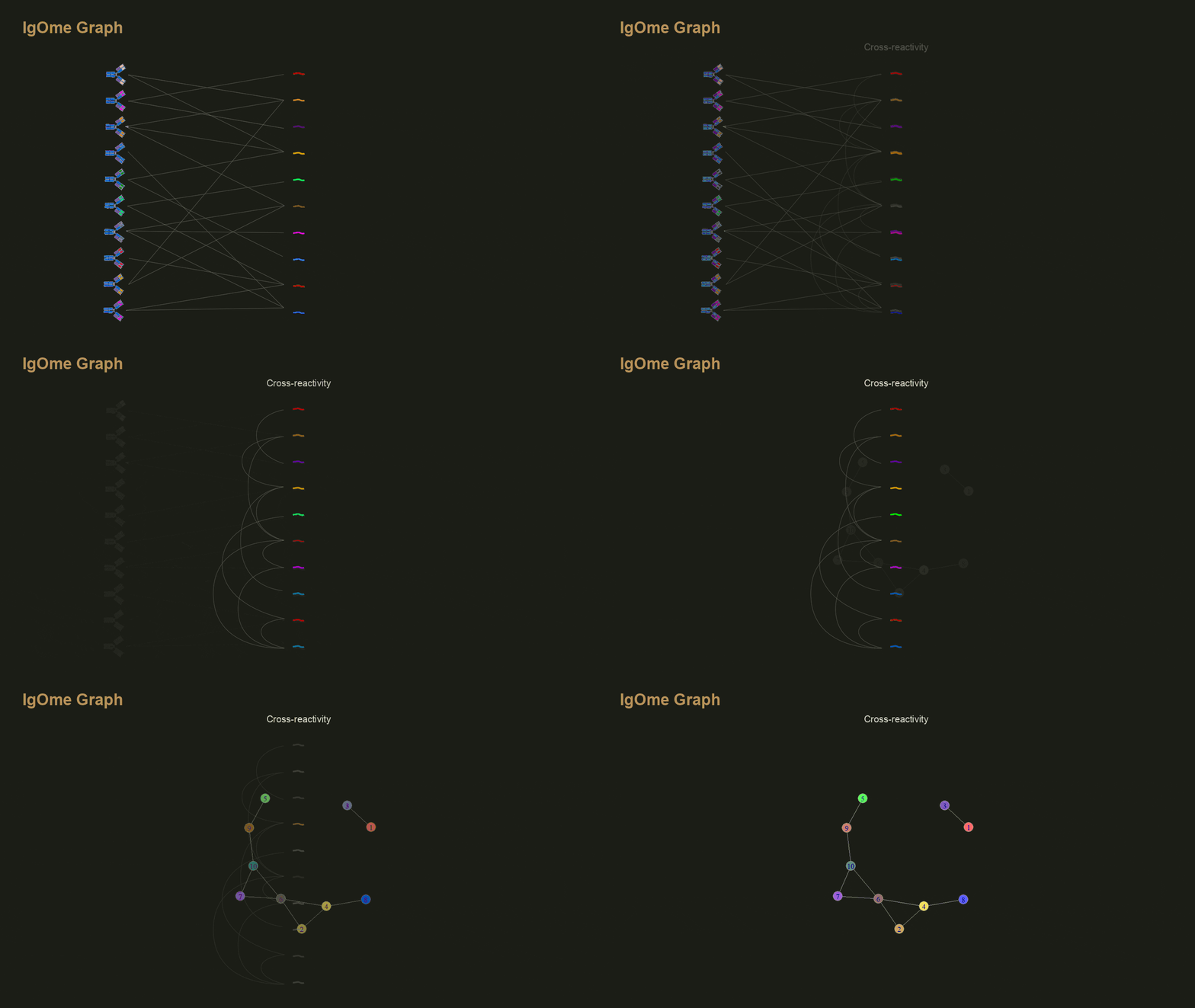
The reactivity graph
Representing whole-repertoire mimotope sets as a graph of cross-reactivities — sequences linked by shared subsequences — then reading its geometry and topology.
03 / Notebook
Thinking in public
Short technical notes: a graph problem worked through, a paper reflected on, a statistical idea tested against real microarray data.
What is studied here
The work unites two complementary windows on the humoral immune system: large libraries of peptide mimotopes selected on single mAbs or whole antibody repertoires, and high-throughput binding measurements that probe serum antibodies against peptide microarrays. Together they can describe the global (cross)reactivity landscape of the entire antibody population — which we represent and interrogate as a graph. It is important to note that the short peptide mimotopes probe partially the paratope and serve more as tokens in the “language” of the reactivity repertoire. That is why an extensive network of cross-reactivties is observed at that level, allowing for the generation of a global connected landscape.
From the notebook
The most recent notes and essays. All writing →